Showing posts with label Turmeric. Show all posts
Showing posts with label Turmeric. Show all posts
Sunday, December 26, 2010
Curry that kills cancer cell
A spicy way has been found to kill cancer cells.
Scientists ave discovered that a substance found in turmeric, a basic curry ingredient, can kill cancer cells within 24 hours.
Researchers at Ireland's Cork Cancer Research Centre who treated oesophageal cancer cells with curcumin, a chemical found in turmeric, observed that it triggers lethal death signals in the cells.
The cells eventually digest themselves and die.
The results of the study were published in the British Journal of Cancer on Wednesday.
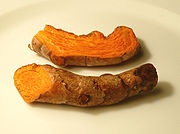
Curcumin gives turmeric (curcuma zangais) its orangy-yellow colour. The rhizome, a close relative of the ginger, is commonly used in Asian cooking as well as in traditional medicine.
Chinese and Ayurvedic medical practioners use turmeric as a treatment for many ailments as it has anti-inflammatory, anti-fungal properties and believed to lower cholestrol.
The results of the Cork Cancer Research Centre study were published in the British Journal of Cancer on Wednesday.
"These exciting results suggest that scientists can develop curcumin as a potential anti-cancer drug to treat oesophageal cancer," said Dr Sharon McKenna who led the study.
She said scientists had known hat natural compounds had the potential to treat faulty cells that become cancerous, adding they also suspected curcumin's possible therapeutic value.
She said medical researcher Dr Geraldine O’Sullivan-Coyne who had been looking for new ways of killing resistant oesophageal cancer cells tested curcumin on resistant cells.
"She found that they started to die using an unexpected system of cell messages."
"Normally, faulty cells die by committing programmed suicide – or apoptosis – which occurs when proteins called caspases are ‘switched on’ in cells."
"But these cells showed no evidence of suicide and the addition of a molecule that inhibits caspases and stops this ‘switch being flicked’, made no difference to the number of cells which died."
"This suggested that curcumin attacked cancer cells using an alternative cell signalling system," she added.
Oesophagus cancer kill more than half a million people in the world each year. The cancers are exceptionally deadly, with five-year survival rates of between 12 and 31 per cent.
The number of oesophageal cancer cases have gone up tremendously since the 70s and this is thought to be linked to rising rates of obesity, alcohol intake and reflux disease.
Source: Cancer Research UK
Published Oct 29 2009


Saturday, November 14, 2009


Plants and Ayurveda
Ayurveda (Devanāgarī: आयुर्वेद, the 'science of life') is a system of traditional medicine native to the Indian Subcontinent and practiced in other parts of the world as a form of alternative medicine.
Ayurveda (Devanāgarī: आयुर्वेद, the 'science of life') is a system of traditional medicine native to the Indian Subcontinent and practiced in other parts of the world as a form of alternative medicine.
In Sanskrit, the word Ayurveda consists of the words āyus, meaning 'life', and veda, meaning 'related to knowledge' or 'science'.Evolving throughout its history, Ayurveda remains an influential system of medicine in South Asia.
The earliest literature of Ayurveda appeared during the Vedic period in India.
The Sushruta Samhita and the Charaka Samhita were influential works on traditional medicine during this era. Ayurvedic practitioners also identified a number of medicinal preparations and surgical procedures for curing various ailments and diseases.
Subscribe to:
Posts (Atom)